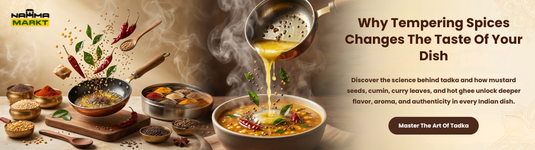
Why Tempering Spices Changes The Taste Of Your Dish
There is a moment in Indian cooking that experienced cooks know well. The oil heats, the first spice hits the pan, and within seconds the kitchen fills with an aroma so specific and so satisfying that it immediately signals what is coming. That moment is tempering and it is the single technique that more than any other explains why Indian food tastes the way it does.
Tempering spices is not simply adding flavour. It is a precise, science-backed cooking method that transforms raw spice compounds into something entirely different more aromatic, more complex, and far more deeply integrated into the dish than any spice added dry or late in cooking ever could be.
If you have ever wondered what is tempering in cooking, why Indian food has that distinctive depth, or how to make your own dal or sambar taste the way it does at a good restaurant, this guide answers all of it. From the science behind the technique to the specific spices for tempering and how each behaves in the pan, this is the complete reference for Indian cooking techniques built around tadka.
What Is Tempering in Cooking?
Tempering known in Indian cooking as tadka, chaunk, or phodni depending on the region is the technique of briefly frying whole or ground spices in hot fat (oil or ghee) to extract their volatile aromatic compounds before incorporating them into a dish.
The key word is volatile. The flavour and aroma molecules in spices are fat-soluble, not water-soluble. This means they do not release into a water-based curry or dal no matter how long you cook them. But when those same spices hit hot fat, the fat dissolves the aromatic compounds instantly and carries them throughout the entire dish. This is the fundamental reason Indian tempering spices produce results that no other spice-addition method can match.
Tadka spices can be used two ways: at the start of cooking (building the base), or at the end (poured over a finished dish). Both are used in Indian cooking, often in the same meal. A dal, for example, might start with a cumin and onion base and be finished with a separate ghee tadka of dried chilli and hing poured directly on top at serving.
Understanding this is the foundation of the Indian spice guide for anyone serious about cooking authentic Indian food.
Why Tempering Works: The Science Behind the Sizzle
When a whole spice like a mustard seed or cumin seed hits oil at around 180–200°C, several things happen simultaneously:
The outer moisture evaporates rapidly, causing the characteristic popping and sputtering that signals the spice is active. This is not just sound it is the moment at which the internal cell walls of the spice rupture and release their contents into the surrounding fat.
Essential oils dissolve into the fat. These oils contain the specific compounds that define each spice's aroma for cumin it is cuminaldehyde, for mustard it is allyl isothiocyanate, for curry leaves it is a group of carbazole alkaloids. Once dissolved in fat, these compounds coat every ingredient in the dish as it cooks.
Maillard reactions begin. The surface of whole spices exposed to dry heat undergoes browning reactions that produce new flavour compounds not present in the raw spice at all. This is why a properly toasted cumin seed tastes deeper and more complex than a raw one.
Hing (asafoetida) transforms entirely. Raw hing has an intensely pungent, sulphurous smell that many find off-putting. The moment it hits hot fat, those sulphur compounds break down and convert into a deep, savoury, almost umami-like base note. This transformation from harsh to complex only happens through heat and fat. It does not happen in water-based cooking. The documented hing benefits in digestion (it contains compounds that reduce gas-forming bacteria in the gut) are a bonus on top of the flavour transformation.
This is the science that explains why Indian tadka ingredients produce results so far beyond what the same spices, added differently, could achieve. It is also why Indian cooking techniques built around tempering have remained essentially unchanged for thousands of years they work because the chemistry demands it.
The Essential Tempering Spices and How Each Behaves
Mustard Seeds (Rai)
Mustard seeds are the first spice added in almost all South Indian and Maharashtrian tempering. They need to pop that rapid expansion as moisture inside the seed turns to steam before the next ingredient goes in. Mustard seeds tempering is the starting signal: the pop tells you the oil is at the right temperature for the other spices to follow.
Black mustard seeds are sharper and more pungent than yellow. Once popped and dispersed through the fat, they add a nutty, slightly bitter note that anchors the entire base of the dish. They are present in sambar, rasam, coconut chutney, most South Indian vegetable dishes, and countless chutneys and pickles.
Available at: Nammamarkt Mustard Seeds
Cumin Seeds (Jeera)
Cumin seeds are the dominant tempering spice in North Indian cooking. Cumin tempering happens at a slightly lower oil temperature than mustard the seeds should sizzle and turn slightly darker within 20–30 seconds, releasing an intensely warm, earthy aroma that defines North Indian dal, jeera rice, and vegetable preparations.
Cumin is also used ground, but for tempering only the whole seed delivers the full aromatic impact. The roasted, fat-infused cumin that starts a dal tadka is a completely different ingredient from the cumin powder stirred in later deeper, smokier, and more complex in ways that are immediately noticeable in the finished dish.
Available at: Nammamarkt Cumin Seeds
Asafoetida / Hing
Hing deserves its own category in any discussion of Indian tadka ingredients. A tiny pinch no more than ⅛ of a teaspoon added to hot fat after the whole spices transforms within seconds into a deep, savoury base note that permeates the entire dish.
The hing benefits are well documented beyond flavour: hing is a traditional digestive aid used in Ayurvedic cooking specifically in lentil-based dishes to counteract the gas-producing properties of legumes. Many Indian cooks add it instinctively to every dal preparation both for the flavour and because their grandmothers always did, with the understanding that it makes the food easier to digest.
Hing is available as a powder (most common) and as a compounded resin block. The powder is easiest to use in everyday cooking. A small amount goes a very long way.
Available at: Nammamarkt Hing
Curry Leaves
Curry leaves are the defining ingredient of South Indian tadka. They go into hot oil after the mustard seeds have popped and the hing has been added and release a bright, citrusy, herbal fragrance that is completely unique in cooking. There is no substitute.
Curry leaves for tempering is not optional in South Indian cooking it is the technique itself. Sambar without curry leaf tempering is missing its most distinctive characteristic. Rasam, coconut chutney, most vegetable preparations from Tamil Nadu, Karnataka, Andhra Pradesh, and Kerala all begin with or are finished by curry leaves in hot fat.
Fresh curry leaves are the most aromatic. Dried curry leaves, which are what most families in Germany use for practical reasons, still deliver excellent results in tempering and are available at Nammamarkt.
Available at: Nammamarkt Curry Leaves
Urad Dal
Urad dal used in tempering is the whole black gram added to hot oil before or alongside mustard seeds in South Indian tadka preparations. When fried, the small lentils turn golden and develop a nutty, slightly crunchy texture that adds both flavour and textural contrast to the finished dish.
Urad dal tempering is particularly characteristic of Tamil and Kannada cooking. It appears in the tempering for coconut chutney, rice dishes like lemon rice and tamarind rice, and vegetable preparations where a slight crunch in the base is desirable. The combination of popped mustard seeds, fried urad dal, and curry leaves in hot oil is one of the most recognisable aromas in South Indian cooking.
Available at: Nammamarkt Urad Dal
Chana Dal
Chana dal in tempering serves a similar purpose to urad dal added whole to hot oil, it fries to a golden, crunchy texture that adds body and nuttiness. Chana dal tempering appears alongside urad dal in many South Indian preparations, the two often used together for a more complex textural base.
In chutneys, particularly coconut chutney, fried chana dal is also ground into the chutney itself as a thickener and flavour base a technique that shows how Indian cooking uses the same ingredient in multiple roles within a single preparation.
Available at: Nammamarkt Chana Dal
Dry Red Chillies
Dry red chillies added whole to hot oil release a slow, rounded heat that infuses the fat and reaches every part of the dish evenly. Unlike chilli powder added later, whole tempering spices of this type produce heat that is distributed rather than concentrated a background warmth rather than a sharp spike.
They also add colour: a single dried Kashmiri red chilli in hot ghee gives the fat a deep reddish tint that carries through the dish visually as well as in flavour.
Available at: Nammamarkt Dry Red Chillies
The Right Fat for Tempering
The fat used for tempering is not interchangeable it is part of the flavour system.
Ghee is the most flavour-forward option. Its nutty, caramelised richness amplifies the spices it carries and adds a characteristic roundness to the finished dish. Dal finished with a ghee tadka of cumin, dried chilli, and hing is one of the simplest and most satisfying preparations in Indian cooking.
Coconut oil is the fat of choice for Kerala and coastal Karnataka cooking. It adds a faint sweetness and tropical character that complements the curry leaves and mustard seeds of South Indian tadka in a way that no other oil quite matches.
Groundnut oil is a neutral, high-smoke-point oil widely used across Maharashtra, Gujarat, and Andhra Pradesh for everyday tempering. It lets the spice flavours speak without adding competing fat character.
All are available at Nammamarkt.
Tempering in Practice: Three Essential Recipes
Tempering for Dal Tadka
The most common application of spices for dal tadka in North Indian cooking:
- Heat ghee in a small pan until shimmering.
- Add cumin seed: wait 20–30 seconds until fragrant and slightly darkened.
- Add a pinch of hing: stir immediately.
- Add dried red chilies: 10 seconds.
- Add garlic (optional) :30 seconds until golden.
- Pour the entire tadka over a finished dal and cover immediately to trap the aroma.
The result is a transformation of a plain cooked dal into something that smells and tastes like it spent much longer cooking.
Tempering for Sambar
Tempering for sambar in South Indian cooking:
- Heat coconut oil or groundnut oil.
- Add mustard seeds wait for the pop.
- Add urad dal and chana dal fry until golden.
- Add curry leaves and dried red chillies 10 seconds.
- Add hing stir immediately.
- Add this tempering to the cooked toor dal and tamarind base, or pour it over the finished sambar.
Sambar powder is added to the sambar base itself before the final tempering the tempering is the finishing layer that ties the dish together.
Tempering for Rasam
Tempering for rasam is lighter and quicker than sambar:
- Heat ghee until very hot.
- Add mustard seeds pop.
- Add cumin seeds 20 seconds.
- Add curry leaves and dried red chillies 10 seconds.
- Pour directly into the thin, peppery rasam broth.
Rasam powder forms the spice base of the broth itself; the tempering finishes it with the aromatic layer that makes rasam smell the way it does.
Both sambar powder and rasam powder are available at Nammamarkt.
Common Tempering Mistakes and How to Avoid Them
Oil not hot enough. Spices dropped into lukewarm oil absorb fat rather than releasing their compounds into it. The result is greasy, flat-tasting spices rather than aromatic ones. Wait until the oil shimmers before adding anything.
Oil too hot. Spices burn within seconds at too-high temperatures, producing bitter compounds that ruin the entire dish. If mustard seeds are exploding out of the pan or cumin is turning black rather than dark brown, the heat is too high.
Wrong order of addition. Whole spices need longer than ground spices. Mustard seeds → urad/chana dal → cumin → curry leaves → hing → ground spices. Each has a different time requirement, and adding them in the wrong order means some burn while others are undercooked.
Walking away. Tempering happens in 60–90 seconds total. It requires full attention for its entire duration. This is not the stage of cooking where you can stir something else or check your phone.
Not covering after pouring. When a finished tadka is poured over a dish, covering immediately for 30–60 seconds traps the volatile aromatics and drives them into the food rather than letting them escape as steam.
Finding Tempering Ingredients in Germany
The full range of Indian tempering spices mustard seeds, cumin seeds, hing, curry leaves, urad dal, chana dal along with the fats and spice blends needed to complete South Indian and North Indian preparations, is available at Nammamarkt.
For anyone looking to buy Indian groceries online in Germany with the specific products needed for authentic tempering, Nammamarkt is the most reliable Indian grocery store in Germany. Whether you are sourcing Indian spices in Germany for the first time or restocking a well-established kitchen, the full tempering range is available with delivery across the country.
Buy Indian spices in Germany from brands you can trust the same ones used in Indian kitchens everywhere — and cook authentic Indian food in Germany exactly as the technique demands.
Final Thoughts
Tempering spices is the technique that separates Indian cooking from most other cuisines not in complexity, but in how completely it transforms the character of the ingredients involved. The same cumin seed that sits inert in a dry spice jar becomes a powerful aromatic agent the moment it hits hot fat. The same hing that smells harsh from the tin becomes a deep, savoury foundation note after two seconds in ghee.
This transformation is what experienced Indian cooks understand intuitively and what the Indian spice guide tradition has always taught: spices must be activated to do their work. Tempering is how that activation happens.
Once you understand what is tempering in cooking and begin to practise it consistently, the quality of every Indian dish you make improves immediately. It is the single most impactful Indian cooking technique to learn, and it takes less than two minutes from start to finish.
For the complete range of Indian tadka ingredients and everything else you need to stock your kitchen, Nammamarkt is your home for Indian groceries in Germany, delivered.
FAQs
1. What is tempering in Indian cooking?
empering (tadka or chaunk) is the technique of frying whole spices for tempering in hot oil or ghee to release their fat-soluble aromatic compounds into the fat, which then carries those flavours throughout the dish. It is one of the most fundamental Indian cooking techniques and the reason Indian food has its characteristic depth of flavour. All Indian tadka ingredients are available at Nammamarkt.
2. What are the essential spices for tempering?
The core spices for tempering are mustard seeds, cumin seeds, hing, and curry leaves. For South Indian tempering, urad dal and chana dal are also added. All are available at Nammamarkt, the best Indian grocery store in Germany for tempering ingredients.
3. What are the hing benefits in cooking and health?
The hing benefits are twofold. In cooking, hing transforms from a harsh, pungent resin into a deep savoury base note when it hits hot fat a flavour transformation that cannot happen through any other method. In digestion, hing contains compounds that reduce the gas-forming effects of lentils, which is why it appears in virtually every dal preparation in Indian cooking. Hing is available at Nammamarkt.
4. How do I make a proper dal tadka?
Heat ghee until shimmering. Add cumin seeds and wait 20–30 seconds. Add a pinch of hing, stir immediately. Add dried red chillies and optional garlic. Pour the entire tadka over finished cooked dal and cover for 30–60 seconds. The spices for dal tadka are all available at Nammamarkt, which is also the most convenient place to buy Indian groceries online in Germany including all tempering essentials.
5. What is the difference between North and South Indian tempering?
North Indian tempering typically leads with cumin seeds in ghee or neutral oil, often with garlic and dried chilli. South Indian tadka leads with mustard seeds in coconut or groundnut oil, followed by urad dal, chana dal, curry leaves, hing, and dried red chillies. The result is sharper, more aromatic, and immediately identifiable as South Indian. All ingredients for both styles are available at Nammamarkt your source for Indian spices in Germany and Indian groceries in Germany.
6. Where can I buy tempering spices in Germany?
Nammamarkt is the most reliable source to buy Indian spices in Germany for tempering covering mustard seeds, cumin seeds, hing, curry leaves, urad dal, chana dal, and dry red chillies, alongside sambar powder, rasam powder, ghee, and cooking oils. It is the most comprehensive Indian grocery store in Germany for families who want to cook authentic Indian food in Germany with the right ingredients.